
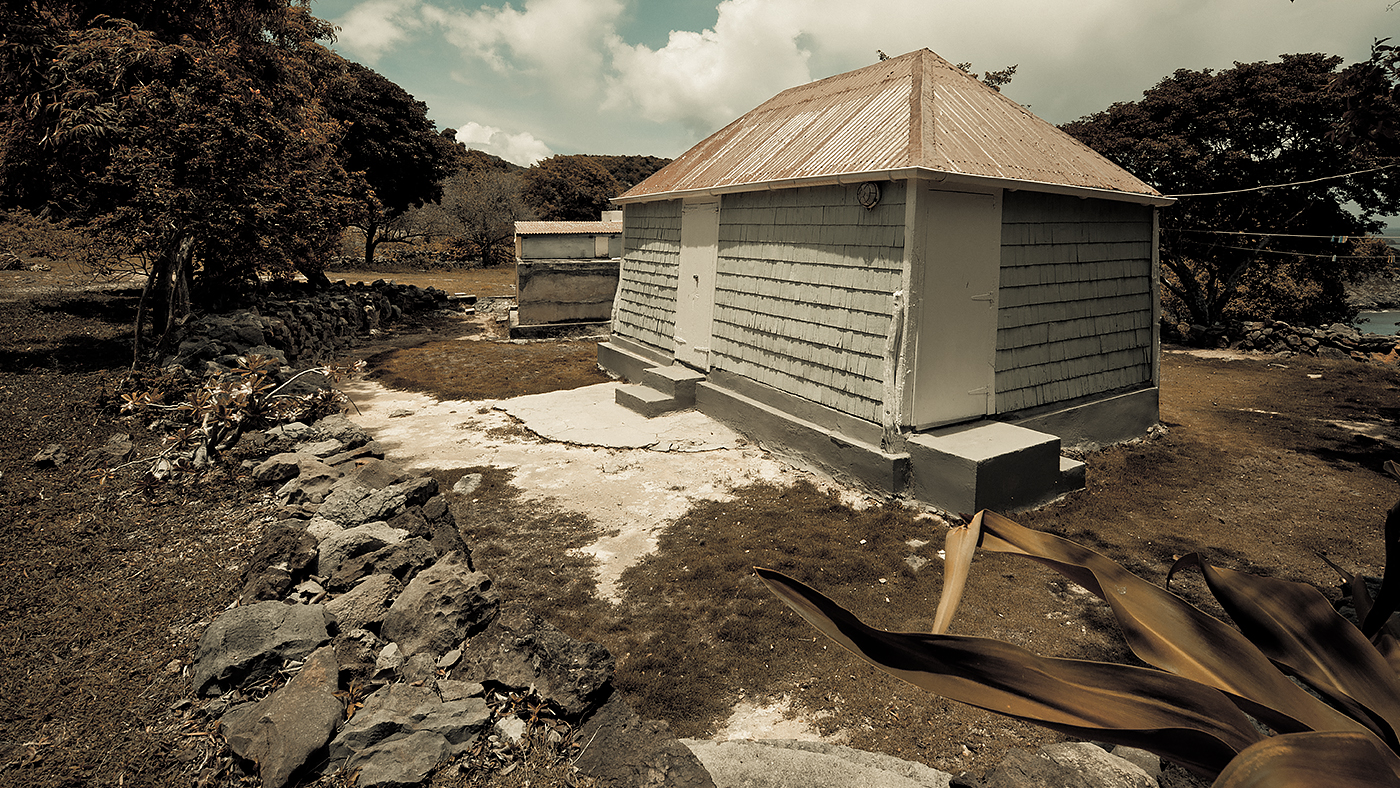
St Barth ‘Cases’
Within a few decades, the island of St Barthélemy became the scene of a considerable development evolving from the strictest destitution, to, sometimes ostentatious ostentation. Nevertheless, the soul of the island which also makes its beauty, and its picturesque charm knew was preserved over the passing years.
The traditional “Cases” St Barth, recognizable with their typical architecture, marked with simplicity and authenticity, testify of this almost recent past when the roughness of the former days’ life, contrasts with the opportunities which are offered in today’s everyday life.
“Any boy reaching man’s age, according to implicit principles of honor, responsibility, had for initial project the construction of his “Case” in order to welcome his home.”
If sun, crystalline water, and soft trade winds accompany the simple evocation of ” St Barthélemy , heavens, over the centuries, were not always clement and by its fulgurances, lavished their cruel learnings. Hurricanes, earthquakes and of course dryness, established de facto major architectural criteria of these “Cases” St Barth.
Any boy reaching man’s age, according to implicit principles of honor, responsibility, had for initial project the construction of his “Case” in order to welcome his home. No matter if we are from ” Sous le vent ” or from “Au vent” coast – a geographical demarcation for two different communities by the language – the choice of the housing environment’s location was determined by the requirements of the climate and the ground’s topography. No matter if the coast is protected from the wind or, animated by the east wind, we found everywhere the same hot sun, the same seismic or cyclonic risks, and of course, everywhere the same water shortage.
With the absence of any drinkable water’ source, it was vital to store the inestimable rainwaters. Showing ingenuity, the old ones adapted themselves! Gutters modelled straight from the built allowed the recovery of the rainwater which ran out in whose contents were infinitely more precious than an oil barrel. Afterward, and according to the earth’s quality, the cisterns, half buried – half only painful work could not resort to the earthwork or to hope for the assistance of tracto shovels – were built near the housing environment and allowed to keep a bit of freshness. Today still and in spite of the accessible tap water for all, it is very rare to plan a building without integrating a cistern in its lower part.
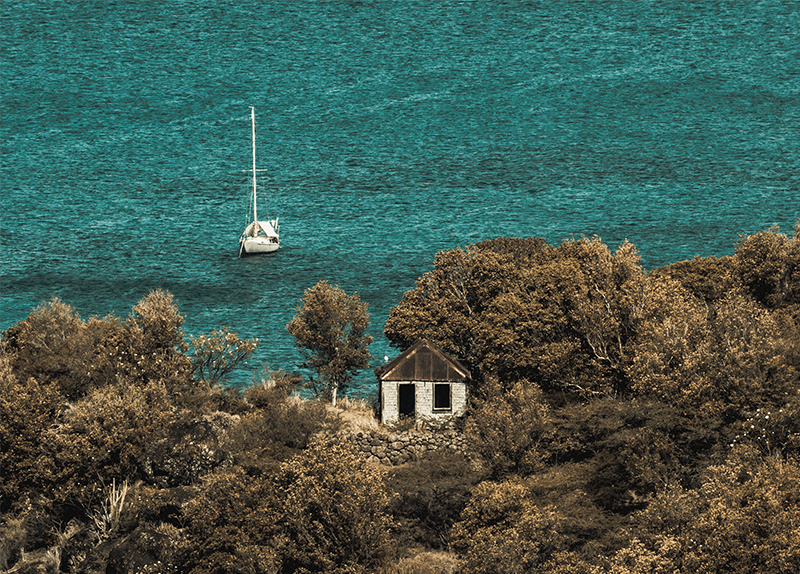
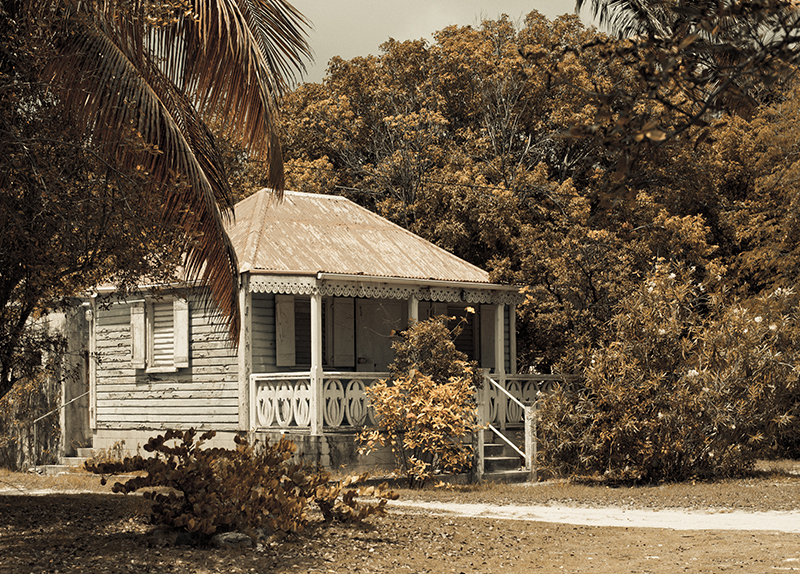
Looking at the composition of walls, dry stones, mainly volcanic origin were used. The binder was made of ground and water, the whole rough-casts with a filler of lime. The lime was prepared according to a St Barth’s knowledge, unique in the Antilles. The men dived to collect “cayes à chaux” (reefs with lime), well-known on the island. Associated with the sap of mancenilliers, this “cayes à chaux” was the object of a slow combustion, whose ashes constituted the relatively fragile basis of the rough coats, which it was advisable to maintain regularly. The lime was mostly transported on the head of the women, and sometimes had as undesirable side effect, the fall of the hair
In the corners of the house it was frequent to find a gaïac or bois de rose completely integrated into the structure, so offering by its grounded roots, a solidity appropriate to support the torments of the weather. In a more symbolic way the same roots represented certain anchoring of the family for this dry ground which had seen them being born.
Raised on a solid base being able to support the telluric sudden starts, the body of the building was constituted with wood. Simple thatched roof in its debuts, the typical roof with four sides, gradually evolved to be composed of essentes, following the example of the dressing of facades, then of sheet steels according to the availability of the present materials.
The kitchen which sheltered the “fouilleu” ( the hearth) was built near the main house building for landing in particular fire risks. As conveniences a simple hole aside was enough for the needs for the family.
Whateveer of guingois or little academic, these traditional “Cases” (houses) whose undeniable charm continues to influence the architects, give evidence of the respect of their inhabitants for the nature a unique local knowledge and constitute by their humility, a real identity of the island of St Barthélemy through time.
Nowadays, the “Collectivité” impose for new constructions, roofs with four sides (as before) and a maximal height of 6m50 (formerly, the highest building did not have to exceed the top of palm trees), to guarantee to the attentive glances a certain harmony and preserve the authenticity of the island. Because of the exiguity of the territory, of an increasing population whose requirements are not any more the same as the ones of former days, these “Cases” (houses) become more and more rare and disappear gradually from the landscape. In order to guarantee the conservation of this heritage, wouldn’t one have to think of classifying them as historic monuments?
In the meantime, in order to, sometimes, remember the good old memories “antan lontan” and to allow its imagination to wander at leisure on the traces of old, you can simply let yourself rock in the hollow a good hammock.